Norrmalmstorg, August 1973
On the morning of 23 August 1973, a man with a submachine gun walked into the Kreditbanken branch on Norrmalmstorg square in Stockholm and took four bank employees hostage. Six days in a bank vault followed. When the drama ended, investigators ran into something they had not anticipated: the hostages were not afraid of their captor. They were afraid of the police. One of them, Kristin Enmark, phoned Prime Minister Olof Palme during the siege and told him she fully trusted the man holding them — what frightened her was that the police would storm in and get them all killed. After their release, the hostages refused to testify against the man who had held a gun to their heads for six days. Nils Bejerot, the psychiatrist advising the police during the robbery, named the phenomenon after the location. The world now knows it as Stockholm syndrome: the victim forms an emotional bond with the aggressor because he shows her the occasional small kindness — and turns her anger on the people warning her about him.
Fifty years later we can watch the same syndrome play out in the EU. The hostage is the entire private sector. The aggressor is the state. And the small kindness consists of the contracts, certifications and guaranteed markets that the state hands out to companies willing to build it an infrastructure for monitoring and controlling everyone — the companies themselves included.
What rent-seeking is
In 1967 the economist Gordon Tullock described, and in 1974 Anne Krueger named, the phenomenon economics now calls rent-seeking. A company can get rich in two ways. Either it creates value people are willing to pay for voluntarily, or it lobbies the political arena for a privilege: a tariff, a subsidy, a licence, an obligation. A regulation that orders millions of people to buy its product. In accounting terms the outcome is identical: profit. The difference is that in the second case no new value is created — wealth is merely transferred from those who produced it to those who bought a legislator. And the resources spent on lobbying, compliance and enforcement are a pure loss to society.
Let me clear up one possible misunderstanding right away, because without it the rest reads as an attack on business. I have absolutely no problem with private companies making a profit. Quite the opposite. Let us play full-blooded capitalism — let anyone enter the market easily, let the customer freely decide whether to be a client or not, and let the company pay out whatever profit it sees fit. That is ordinary business and nobody else’s concern.
The problem is precisely the combination we have today: the state orders everyone to pay for a private company’s service, the customer cannot opt out, the market cannot be freely entered — and the company pays out profit from these involuntary payments. That is not capitalism. That is immoral. And in exactly this sense Slovakia is a textbook of rent-seeking. Consider what we have come to regard as “normal”:
Mandatory health insurance with private profit. Every employee in Slovakia is compelled to pay a percentage of their wage — and part of it flows to private shareholders. The Value for Money unit of the Ministry of Finance put it bluntly: “The possibility of paying out profit to shareholders of health insurers within a compulsory system is not found in any EU country except Slovakia — and in the USA.” Switzerland also runs compulsory insurance through private insurers, but the law forbids them from making a profit on the basic package. And the Netherlands? Dutch law does not actually ban dividends — a bill to ban them cleared the lower house in 2017 and has been stalled in the upper house ever since. No Dutch health insurer pays any all the same, because they are all mutuals and cooperatives without private shareholders. Not a prohibition, then, but something more durable: it never occurred to anyone there to build a joint-stock company on top of compulsory contributions. Here, the Penta financial group extracted roughly €550 million from the Dôvera insurer between 2010 and 2020, having put in about €34 million; the insurer repeatedly took out bank loans to fund those dividends and is today suing the supervisory authority that is blocking a further €176 million payout. When the state tried to ban such profits in 2007, the Constitutional Court struck the ban down and Slovakia faced international arbitration. The rent is better protected than the patient.
The heart of the problem, however, is not that the insurers make money. It is that there is no way out of this system. You cannot say you will arrange your healthcare cover differently, you cannot choose not to fund any of these companies, and you cannot refuse to pay — it is compulsory. And that single word is what turns profit from a reward for a service well rendered into a rent collected under threat of sanction. If you could leave at any time, an insurer’s profit would be evidence that it is doing something right. When you cannot leave, it is evidence only that it has a good law.
Compulsory employee meals. Section 152 of the Labour Code orders every employer to “provide” employees with food. Not to allow — to provide. Even the Czech Republic, with whom we shared this tradition, now only requires employers to “enable” meals; the employee there has no legal entitlement to anything. In Slovakia a cartel of meal-voucher issuers fed on this obligation for decades: companies charging commissions on both sides of the transaction, which the Antimonopoly Office fined nearly three million euros in 2016 for carving up the market. According to the INESS think tank, small restaurants paid 5–6 percent of face value to redeem the vouchers — accepting a meal voucher was roughly five times more expensive than accepting a payment card. In 2016 the issuer Up Slovensko posted a €5 million profit on €12.8 million of revenue. A forty-percent margin — on an obligation.
Compulsory motor third-party liability insurance. This exists across the whole EU, so it is no Slovak peculiarity. The Slovak peculiarity is that the state carves its own rent out of a compulsory product: insurers hand over 8 percent of every premium collected to the Ministry of the Interior, rising to 10 percent from 2026. The insurance association calls it a hidden tax — and it is paid, naturally, by the driver in the price of a compulsory policy.
We could go on: 1.58 million compulsory vehicle inspections a year at stations with regulated market entry, compulsory energy certificates for every property sale or lease, compulsory chimney inspections several times a year. Every single one of these obligations has its own cohort of firms living off it. And which will therefore defend it tooth and nail, lobbying to extend it. That is the essence of rent-seeking: a compulsory market, once created, is never voluntarily abolished.
eKasa: the dress rehearsal
One example deserves its own chapter, because it is the closest relative of e-invoicing and we already know how it turned out.
Since 2019, every one of roughly 230,000 cash registers in the country must be connected online to the Financial Administration, Slovakia’s tax authority. Textbook rent-seeking: the law ordered hundreds of thousands of businesses to buy certified hardware from a narrow group of certified manufacturers, with entry costs starting around €380. A market born not of demand but of a statutory provision. In exchange, the state promised it would collect roughly €120 million more per year. Nobody has ever evaluated that promise after the fact. The VAT gap had in any case been falling for years before eKasa, thanks to the VAT ledger statement introduced in 2014. And despite eKasa, Slovakia still had one of the highest VAT gaps in the EU as late as 2022.
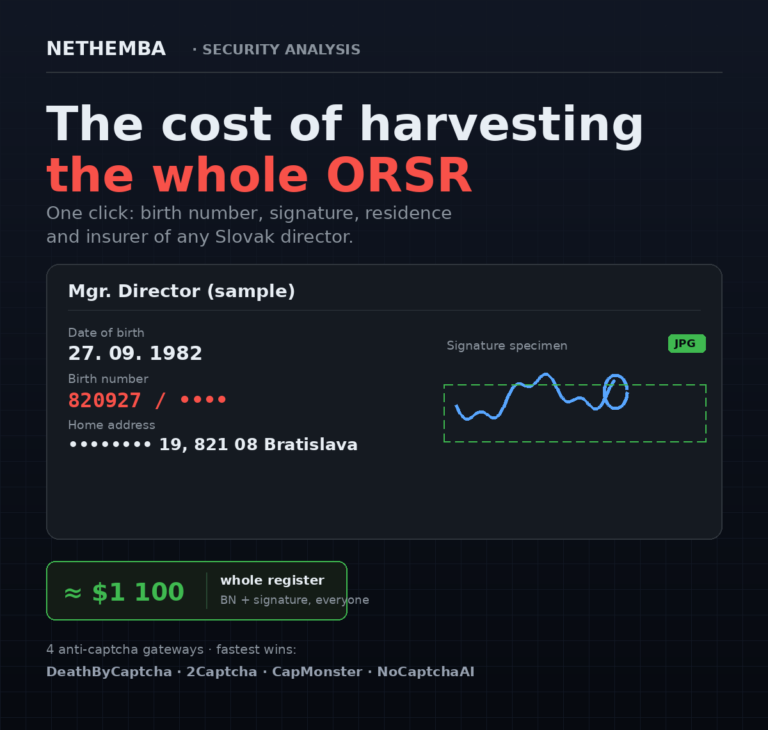
I wrote about eKasa when it was being introduced, calling it another small step towards a great financial dictatorship in Slovakia. And it did not stop at the writing. At Nethemba we ran a professional security assessment of the protected data storage module — the certified component on which the credibility of the entire system rests. The result is still worth reading years later.
The protected data storage is supposed to be memory that can only be written to, from which nothing can ever be altered or deleted. The whole logic of the system rests on that. Except that the cash register software does not verify — and under the given conditions cannot verify — whether the attached storage module is genuine. The data inside it is freely accessible and the communication between register and storage is not encrypted. So we built an emulator that imitates the real module perfectly. A classic man-in-the-middle attack. The certified register then keeps issuing receipts, it simply never sends them to the tax authority. The emulator also allows original receipts to be reprinted — meaning businesses can lend each other a storage module at month’s end and print as many expense receipts as they need, VAT deduction included. The VAT ledger statement will not catch it, since it does not track small retail sales at document level.
Let me stress that we never published the emulator. We offered the source code solely in case the Financial Administration refused to take the vulnerability seriously — as an insurance policy, not as a tool. I mention it because it matters for what follows: we were not the only people in the world capable of finding that hole, and whoever found it with different intentions did not report it to anyone.
To sum up. A system meant to guarantee the incontestability of tax data can be bypassed with an emulator. A device the entire country was forced to buy does not guarantee the one thing it exists for. According to the estimate of MP Eduard Heger at the time, it cost businesses €60–80 million in hardware alone. The state, meanwhile, still pays €1.1 million a year to run the system to All Soft Corp — formerly Allexis, the company from the Mýtnik corruption case — having approved almost €4.7 million net of VAT to it through contract addenda alone. The whole project is due to be replaced by a new system called SWERP anyway.
Remember this, because we will need it shortly: the obligation and the costs stayed with businesses, the rent went to the supplier, the data to the state. The security that justified the whole thing was marketing — it does not actually exist.
E-invoicing: rent and surveillance in a single package
If eKasa was the dress rehearsal, this is opening night. In December 2025 the Slovak parliament passed Act No. 385/2025 Coll., an amendment to the VAT Act which from 1 January 2027 introduces mandatory electronic invoicing for all domestic business-to-business transactions. A PDF sent by e-mail will cease to be an invoice for VAT purposes. An invoice will only be structured XML transmitted through a certified intermediary — which the Financial Administration affectionately calls a “digital postman”.
Let me state plainly what follows and what does not, so we do not argue needlessly. I am not against electronic invoices. I use them myself, they are cheaper and faster than paper, and if companies chose them voluntarily I would have nothing to add. Read the title of this article precisely that way: not against the technology, but against a compulsory toll collector standing between me and my customer — and against what is being built alongside it under the banner of digitalisation.
Read carefully who this applies to. VAT payers must issue e-invoices. But receiving them is compulsory for every taxable person — every limited company, every sole trader, lawyer, landlord, and even non-VAT-payers who will never issue a single invoice. All of them must contract a digital postman. A private company. As of June 2026 there were 34 certified providers with another 16 awaiting accreditation — from Slovak software houses all the way to Ernst & Young. There is no free state alternative; eKasa at least offered a free virtual register for the smallest businesses, whereas here the Financial Administration simply points to the market. The state legislated a new sector into existence and ordered several hundred thousand entities to become its customers. Tullock would applaud.
How many exactly? The government knows, and wrote it into the regulatory impact analysis in the explanatory memorandum to the act: 530,726 affected entities. And now the interesting part — what it thinks this will cost. It quantified the impact on a single business at €26 per year. For the second regulation, the data reporting obligation, at a further €32. How did it arrive at that? It modelled the whole thing purely as administrative time: 120 minutes once a year, electronically. In the “other fees” column it entered zero. The subscription to the digital postman — the one item companies will actually be paying — does not appear in the calculation at all.
Compare that with what state institutions themselves say about the price. The Financial Administration estimates the postman’s fee at €5–12 per month, that is €60–144 a year. The Value for Money unit goes further, writing in its project assessment that comparable services available on the market carry “annual costs per entity starting at €240“. That is nine times what the official analysis of the government’s own law assumes.
Let us do the multiplication — and I stress that the following figures are my own calculation, not an official one. At the rate quoted by the Financial Administration, the private sector will pay €32–76 million a year. At the rate quoted by the Value for Money unit, €127 million a year. The state, meanwhile, is investing €46 million over ten years in the entire central infrastructure, that is just under €5 million a year. So the private sector will pay, every single year, between seven and twenty-seven times what the whole project costs the state — and it will pay forever, because subscriptions do not end. The official impact analysis nonetheless claims the law will bring businesses a net saving of €19.8 million a year.
And that figure of 530,726 is itself an undercount. It is made up of three components, and the largest of them — some 240,000 entities not registered for VAT — covers legal persons only. It therefore omits natural persons who are not VAT payers: sole traders, lawyers, notaries, artists and landlords, about whom the Financial Administration explicitly states in its own guidance that “you must contract a Digital Postman in order to receive e-invoices”. According to the Statistical Office there are more than 340,000 active sole traders in Slovakia. The government, in other words, failed to count its own rule.
But the postman is not merely a postman. The moment he delivers your invoice, he automatically generates a so-called Tax Data Document from it and sends it to the Financial Administration’s system — in its own words, “in near real time”. From 2027 the state will therefore see every invoice between businesses in Slovakia practically at the moment it comes into existence. Who billed whom, when, for how much.
Enforcement does not rest primarily on fines, though those bite — up to €10,000, and up to €100,000 for repeat offences. It rests on something far more effective. Once a PDF stops being an invoice, proving entitlement to a VAT deduction becomes a problem — and from July 2030 the e-invoice is set to become a direct condition of that deduction. That is the real whip: not an official with a fine, but a customer who cannot afford to accept a paper invoice from you because it would cost him his deduction. The system enforces itself, through your own clients.
Let us also be precise about what the state actually receives. The Financial Administration insists that “electronic invoicing is not a tool for monitoring businesses” and that only “data within the scope required by the VAT Act” will be transmitted. Let us take that seriously — today this is probably true, and the reported package is a subset of the invoice. Except that the invoice itself travels as full structured XML containing every line item, quantity and price, and it passes through certified intermediaries. The rails, in other words, are laid for complete data even if only part of it runs on them today. And that is the whole trick: widening the scope of reported data will no longer cost a single euro or a single day of work — an amendment suffices. The cost of additional surveillance dropped to zero the moment businesses paid for the infrastructure. A database of every commercial relationship in the country is a tool for monitoring businesses by definition, regardless of what it is currently used for. What matters is that it exists. A purpose is always found later.
This is where our experience with the eKasa module comes in handy. State certification is not the same thing as security — it is a stamp on a piece of paper. With eKasa we verified that in practice: a module that was supposed to be unbreakable by statute could be emulated. With e-invoicing the stakes are an order of magnitude higher. The complete commercial relationships of an entire country — who supplies whom, what margins anyone runs, whose revenue is falling — will flow through some fifty private companies. For industrial espionage, competitive intelligence and plain ransomware alike, this is the single most lucrative target ever created in Slovakia. And liability? You must archive invoices for ten years; the postman has no such duty. The risk is socialised, the profit privatised.
Now let us be fair to the other side for a moment, because without that this whole argument is mere ideology. VAT fraud is real and it is not small. Carousel fraud drains billions from European budgets and the honest entrepreneur pays for it twice: once in higher taxes, and again by being undercut by a competitor who simply does not remit VAT. The idea of a single technical format also has its logic — less re-keying, fewer errors, faster payment matching. The argument in this article is therefore not that the state should not collect taxes. It is that this particular instrument does not deliver even what it is justified by, while as a by-product it builds an infrastructure none of us would hand over voluntarily.
Its defenders will say Brussels demands it. It does not. The European ViDA directive requires electronic invoicing only from July 2030 and only for cross-border transactions within the EU. The obligation for purely domestic invoices, three years earlier, is a free choice of the Slovak government — classic gold-plating.
Its defenders will also say VAT collection will improve. The best answer to that comes from the Ministry of Finance itself. Its Value for Money unit wrote, verbatim, in the project assessment: “The mere introduction of mandatory electronic invoicing, however, need not substantially increase VAT collection; not even the Financial Directorate’s own study assumes it will.” The state’s own analytical unit is saying that a measure which will burden every company in the country probably will not deliver the one thing it is officially justified by — and the state is pouring €46 million over ten years into its central infrastructure regardless. The government set itself no quantified revenue target at all, something the Association of Slovak Entrepreneurs also criticises when it warns that e-invoicing “may end up as another eKasa fiasco”: Slovak firms were given roughly 16 months to implement it, while Germany, Italy and Poland allowed 500 to 1,000 days.
The evidence from abroad is more interesting than either side would like. Italy introduced mandatory e-invoicing in 2019 and its VAT gap genuinely did fall, from roughly 20 to 14.5 percent. By 2023, however, it had climbed back above 15 percent and remains above the EU average — after seven years of the system running. The effect was real, then, but temporary: the fraudsters adapted, as they always do. Poland’s KSeF system, meanwhile, collapsed under its own architecture before launch — an audit found poor design, a high error rate and security holes, and the launch was postponed for years.
And then there is Hungary, which has the best VAT collection in the region with a gap of 7.4 percent — while imposing on companies neither a mandatory invoice format nor a mandatory intermediary; reporting the invoice data is enough. Let us admit outright that this example solves only half the problem: the Hungarian state sees invoice data in real time exactly as the Slovak one will, so on privacy grounds it is no help. What it does prove is the part that matters for the entrepreneur’s wallet — tax collection can be improved without ordering every entity in the country to pay a private company to deliver its own mail. Rent and surveillance are two separate things, and Slovakia chose both at once.
The rest of the world manages without any of it. The United States has no mandatory e-invoicing whatsoever, in Switzerland business-to-business invoicing is entirely voluntary — and even the Czech Republic has no domestic mandate.
So, once more: a measure that according to the state’s own analysts will not increase tax collection, that Brussels does not require, that the international evidence does not support — what exactly is it for? Only one answer remains: the state acquires a complete, machine-readable, near-real-time map of the financial flows of the entire economy. And the private sector will build it, run it and pay for it.
Corporate Stockholm syndrome
And here we return to the vault on Norrmalmstorg. Because part of the private sector welcomes e-invoicing enthusiastically. Software houses, postmen, consultants, the Big Four — for them 2027 is a holiday: hundreds of thousands of compulsory customers delivered by statute. Accounting software vendors are already selling “e-invoicing readiness” as a premium feature. These players will not protest against the obligation. They will defend it — and explain at industry conferences how necessary and modern it is.
What makes it most absurd is who is saying it. These are companies for whom the free market is supposed to be the holy grail. In their presentations they talk about entrepreneurial spirit and innovation, they complain about bureaucracy, they quote Hayek on LinkedIn and explain that the state ought to get out of business’s way. And then those same companies queue up for certification to secure their share of a contract whose entire purpose is to abolish the free market. Because from January 2027 nobody will be able to choose whether to send an invoice by e-mail, through a postman, or at all.
Let us say it plainly: a market in which you are not allowed to decide against buying is not a market. It is tax collection with a private collector. And these companies are not abandoning the free market because anyone is forcing them to — they are abandoning it voluntarily, business plan in hand, because demand created by a statutory provision is more comfortable than demand you have to earn with a product. Once you have tasted a customer who cannot leave, you rarely go back to competing.
We should be precise here, otherwise this sounds like cheap name-calling. Entering this business is no trauma — it is cold calculation, and the firms know exactly what they are doing. Stockholm syndrome sets in at the second step: when those same companies begin to publicly defend the obligation. When they side with the ministry against their own customers in the legislative consultation process. When criticism of e-invoicing starts to feel, to them, like an attack on themselves. That is precisely what the Norrmalmstorg hostages did — not that they thought the robbery was a good idea, but when it came to testifying after their release, they took their captor’s side and turned their anger on the people who had tried to rescue them.
That is the real parallel. Not the profit, but the defence of a system that will ultimately devour you. The firms building the state’s surveillance infrastructure today do not realise — or do not wish to admit — that the same machinery will one day be turned against them. Not out of malice, but in the nature of things: appetite grows with eating.
You do not have to take my word for it; just look at a recent case. The crypto sector in the EU was in exactly this position. Part of the industry openly welcomed the MiCA regulation — it promised legitimacy, clear rules, an end to the wild west, a single passport to a market of 450 million people. “Let’s cooperate with the regulator, we’ll be seen as serious partners.” And the result? Before MiCA, Europe had more than 1,200 registered crypto service providers according to Euronews and more than 3,000 according to other sources. By July 2026, when the licensing cage finally closed, 312 had survived. Depending on which of those two estimates you use, that is one in four — or one in ten. In Slovakia, six firms survived. Six. Industry estimates put the cost of a licence at €300,000–700,000 in the first year alone; for a small innovative company that is a death sentence.
The main event, however, is still to come: not even Binance got a licence. The world’s largest crypto exchange. In June 2026 it withdrew its application in Greece and from 1 July it informed users in France, Italy, Poland, Spain and other EU countries that it could no longer provide them with services; clients with open positions were given until October, after which those positions are liquidated automatically. Fairness requires adding that some large players do hold a licence — Coinbase, Kraken and OKX — and the single passport suits them well. But that is precisely the entire list of winners: a handful of corporations with armies of lawyers and compliance departments. If the world’s number one cannot get through, which smaller firm should expect to?
And those who survived and dutifully paid for their licences did not get peace — they got another round. Since 2026 the DAC8 directive requires them to report every transaction of every client to the tax authorities, and from July 2027 the AMLR regulation will forbid them from touching anonymous accounts and privacy coins. Coinbase CEO Brian Armstrong named the problem back in 2022: “Imagine if the EU required your bank to report you to the authorities every time you paid your rent merely because the transaction was over 1,000 euros.” Does that sound absurd? It is exactly the principle we are now introducing for every Slovak invoice. And lest anyone doubt that the machine never stops: barely 18 months after MiCA came fully into force, the Commission opened a consultation on revising it.
That is the heart of the matter. Heavy regulation is not the enemy of large firms, it is their best friend — it clears the market of competitors, and costs that merely scratch them will kill the small. Today’s enthusiastic builder of surveillance infrastructure should ask himself a single question: am I certain that in the next round I will be one of the six?
What was totalitarian yesterday is “protection” today
Try a thought experiment. It is 2015 and someone tells you that within ten years the European Union will: permit the blanket scanning of private messages without a court order; prepare mandatory age verification by ID document or face scan for e-mail and messaging; plan a central digital currency with a cap on how much of it you may hold; ban cash payments above a set threshold across the bloc; and run a programme to break encryption by 2030. You would say: that is a description of China. In 2026 it is a description of Brussels.
I am not exaggerating, and three examples will do. The so-called temporary derogation allowing platforms to scan private communications en masse — Chat Control — was extended to 2028 in July 2026 despite a majority of MEPs voting against it: 314 votes against, 276 in favour, but blocking it required an absolute majority of 360. Read that again — the majority was against and the measure stands anyway. An amendment asking that only court-flagged accounts be scanned also failed. Meanwhile the Council’s text for the permanent regulation contains mandatory age verification for e-mail and messaging services — the end of anonymous communication in Europe. More than 500 cryptographers and security researchers have opposed it; Signal president Meredith Whittaker announced that Signal would leave the European market rather than weaken its encryption — in her words, it is “surveillance wine in safety bottles”.
The digital euro is on the same trajectory. The Council and the parliamentary committee have already adopted their positions, the ECB speaks of possible issuance in 2029 and has analysed a holding limit of around €3,000 per person. The ECB swears the currency will not be programmable — yet in China, a decade ahead with its digital yuan, central bankers openly tout programmability as a feature: money with an expiry date, or money spendable only at designated merchants. Incidentally, the Slovak parliament wrote the right to pay in cash directly into the constitution back in 2023, explicitly out of fear of a compulsory digital euro — so even our own MPs can see what is coming.
And third, cash and encryption, which are two sides of the same coin. From July 2027 the AMLR regulation imposes an EU-wide ban on cash payments above €10,000, and the same instrument bans anonymous crypto accounts. In parallel, under its ProtectEU roadmap the Commission has committed Europol to building decryption capabilities by 2030 — that is, to breaking precisely the protection the state spent decades recommending that citizens use. Once cash and encryption are both gone, there is no remaining way to transfer value or send a message without a third party knowing about it.
Notice the common denominator running through all of it: the state never spies by itself. It always hires — or rather conscripts — the private sector. Messages will not be read by a civil servant but by an algorithm belonging to Meta and Google. Age will not be verified by the police but by platforms using Google’s and Apple’s infrastructure. Suspicious payments are not reported by an intelligence service but by your bank, your accountant, your crypto exchange — and from 2027, by your digital postman. MEP Patrick Breyer summed it up exactly: criminal justice is being privatised, and corporate algorithms will decide who counts as a suspect. The state rents the dirty work from the private sector — work it is either forbidden or unable to do itself — and the private sector happily invoices for it. For now.
A call to companies: look at who is sitting in the vault with you
This is a message for every Slovak software company currently integrating Peppol; for every accounting firm selling “e-invoicing readiness packages”; for every certified postman on the Financial Administration’s list; for every consultant running compliance training.
And so it is clear where I am writing from: at Nethemba we do not work for the state and state institutions, and do not wish to. It is not a pose but a commitment we made publicly through the “We don’t work for the state” initiative. The reason is simple and applies to this subject too: we consider it ethically inconsistent to criticise the state and work for it at the same time. I am not rejecting someone else’s rent from the comfort of having already collected my own. I reject it where it would suit us as well — and yes, it has cost us contracts.
Nobody blames you for wanting to earn a living. Business means seizing opportunities, and in the short term e-invoicing is an opportunity of the first order: half a million customers driven to your door by statute. But if you profess to believe in the free market, ask yourself what you are actually building — and do the other half of the calculation, the long-term one. The system you are building today gives the state complete visibility into the financial flows of every company, yours included. Every instrument of control you help build will eventually be used to the full; not because politicians are evil, but because no state in history has ever left a powerful tool idle. Today it is “only” VAT. Tomorrow invoice data will serve targeted levies, sectoral taxes, price caps or automatic penalties — and perhaps you will be the “untapped reserve” reached for in the next round of fiscal consolidation. A sector the state created itself can be re-regulated, taxed or nationalised by the state with a single provision. The crypto firms are living proof: those who eagerly helped build the machine were not spared, merely eaten later.
And if you are neither a software company nor a postman nor a consultant — if you are simply one of those more than half a million firms who will have to pay for all of this and get nothing out of it — then this concerns you most of all. You are the majority. You are the ones whose costs the impact analysis forgot to count. And in the legislative consultation process you have exactly the same voice as those who stand to profit. The only difference is that they use theirs.
So what should you demand? Not “better implementation” — that is the language by which every obligation is ultimately pushed through. Demand three concrete things.
First: abolish the compulsory intermediary. Hungary proves it can be done — invoice data can be reported directly, without every entity in the country having to pay a private company to deliver its own mail. If the state insists on reporting, let it build the interface and let its use be free. Rent is not a necessary component of digitalisation; it is a political choice.
Second: do not go beyond what Europe requires. Brussels wants cross-border invoices from 2030. Domestic Slovak B2B from 2027 was the government’s own invention. Gold-plating can be repealed with the same pen that wrote it.
Third: minimise the data and open the specifications. Only what is genuinely needed to compute VAT should leave for the state — not the entire contents of the invoice with line items, units and prices. Add open specifications and independent security audits to that, rather than a certificate as a rubber stamp. With eKasa we saw exactly how much such a stamp is worth.
Use the legislative consultation process for this, support those fighting gold-plating, and say it out loud at the conferences where e-invoicing is currently being celebrated as “digitalisation”.
And finally, remember Kristin Enmark. It took her years to understand what had happened to her in that vault — at the time she was sincerely convinced her captor meant well. Slovak companies have been sitting in a vault with the state for thirty years now. Every so often they are thrown a bone: a contract, a certification, a guaranteed market. Many have grown fond of it. But do not mistake a captor for a partner — a partner leaves you free to walk away. From 1 January 2027, try issuing an ordinary invoice without his postman, and you will find out which of the two of you is holding the submachine gun.
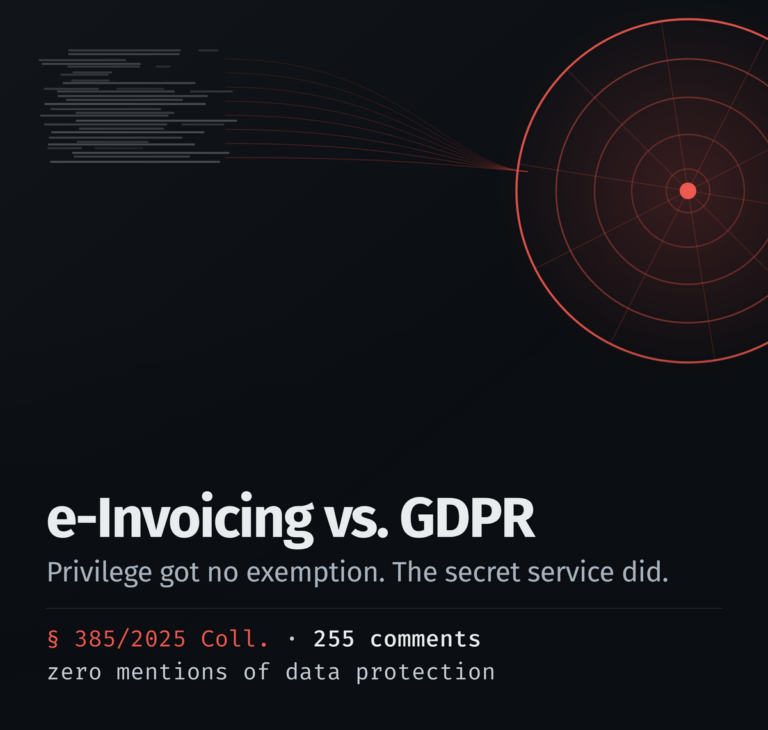
Follow-up: in e-Invoicing vs. GDPR and Professional Secrecy we went through the entire legislative file, including all 255 consultation comments. The act contains not one mention of personal data protection, no impact assessment (DPIA) exists — and in that same consultation the bar association asked in vain to shield client identities, while the secret service secured exactly that for itself.
Sources are linked directly in the text. The legislative situation is described as of August 2026; negotiations on the Chat Control regulation and the digital euro are still ongoing. This article was originally written in Slovak — the Slovak version is the authoritative one.