






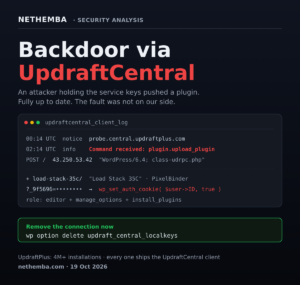
Critical security problem in UpdraftCentral: an attacker holding the service’s keys planted a backdoor on our websites
On the night of 19 October 2026 an attacker abused UpdraftCentral, the remote management service built into UpdraftPlus, a backup plugin with more than 4 million installations, and planted a backdoor on two of our three websites. Our sites were fully up to date and the fault was not on our side: the attacker signed the commands with valid keys that the UpdraftCentral Cloud service generates and keeps. We publish an analysis of the backdoor, indicators of compromise and a...
Read More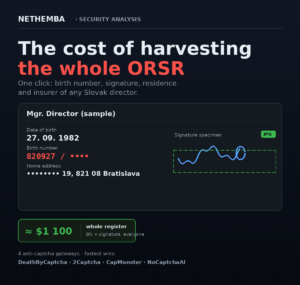
We built an ORSR aggregator and priced out harvesting the whole register (the birth number, signature and health insurer of every Slovak company owner)
In one evening we built an AI-assisted ORSR aggregator: one click gives the birth number, signature, home address and health insurer of any Slovak company director. And we priced out harvesting the entire register: the cost of a used laptop.
Read More
The State as the Biggest Threat to Your Privacy
A senseless Slovak statute published the birth numbers, addresses and certified signatures of company directors — and it is not a bug, it is written into Section 100(3). We are convinced the greatest threat to citizens privacy today is the state itself.
Read More
